
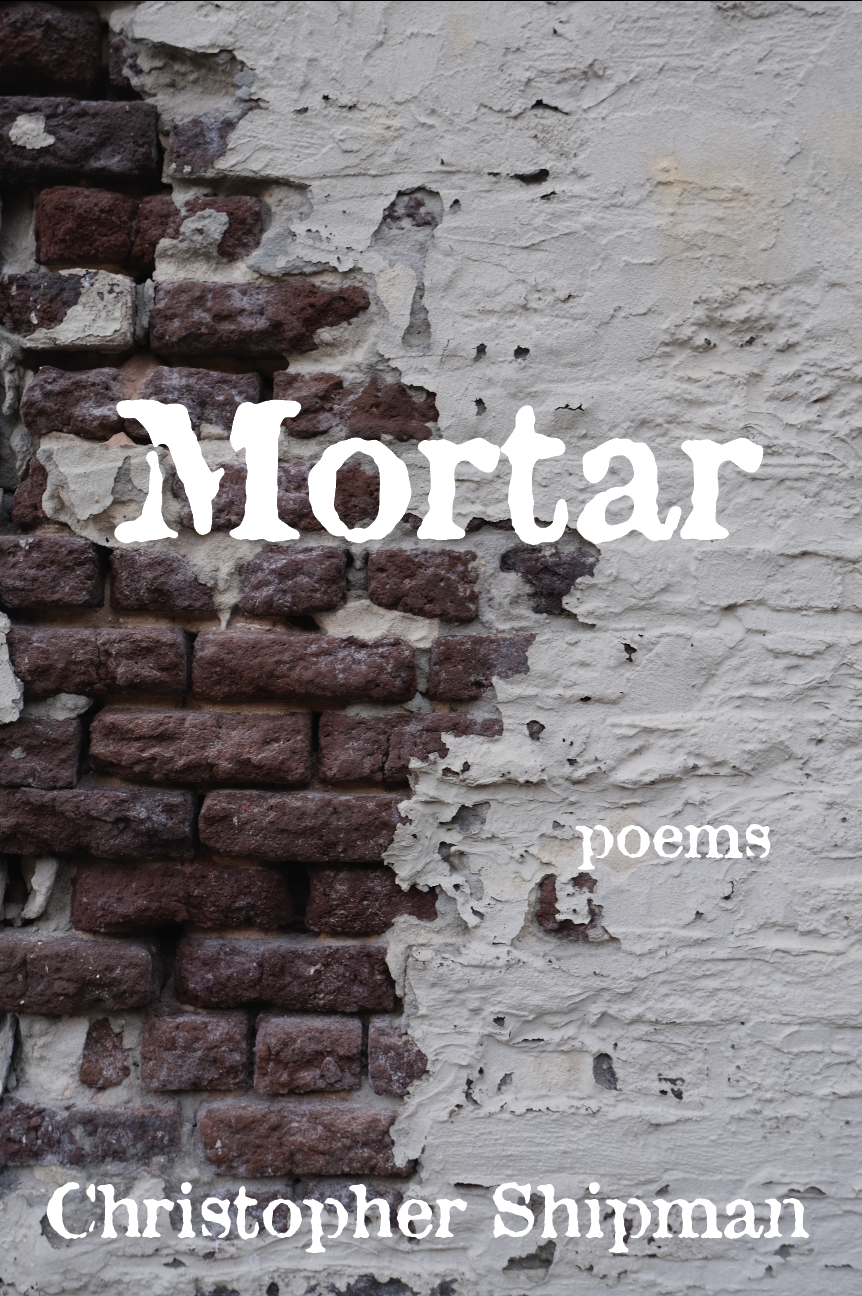
A Review of "Mortar" by Christopher Shipman (Brick Road Poetry Press, 2025)
 Once my father told me everything I love / deserves a name.
—Christopher Shipman, from “The House After It Happened”
Does how we die define our story? There are many ways to die. In hospitals, in anonymity…bludgeoned with a brick.
In Mortar, Christopher Shipman navigates the gruesome murder (with a brick) of his grandmother by her brother-in-law and the titular murder weapon. Shipman’s poems have a way of turning in unexpected places, expertly wending their ways towards uncomfortable truths—un-comfortability that is flirted with and never shied away from. The poems’ turns often find ways to double back on themselves, exploring the recursive nature of time and family. Of his daughter he writes, “I see in her brow the furrowed ghost / of my boyhood.”
Mortar is full of ghosts, its exploration of haunting a simultaneous trauma spelunk, delving ever down into the dark place that is needed to reconstruct identity and forming unexpected unions, unexplored relationships, and the bonds we never wish for: “Evidence suggests telling the story / of trauma can create / new trauma.”
The poems, which often unfold like dreams, are moving. These are poems that take themselves, on the page, where they need to go, ambulating, and on the way investigating family (especially parenthood), place (especially The South) as well as pop culture, wild onions, and horses.
Mortar is composed of a smart variety of types of poems, resisting both patterns and predictability. At times unpunctuated, others in solid prose, others making use of strongly enjambed lines, and always narrative, Shipman shapes a family tree like “A constellation / shipwrecked in a memory / the sky / can only vaguely shape.”
Alternating between the voices of expert bricklayers, hurt children, frank parents, and an omniscient third-person narrator who, in italics, ties the collection together, Mortar pushes past discomfort: “I have to swim out / to the middle of the river / where the current rushes. I have to / love the carnage of its spell.”
Shipman’s unifying voice is that of someone with hands rough from work and a timbre of outspoken wisdom. From what can we make of something like a gruesome murder? And how do we recover from trauma? These are the questions answered, brick by brick.



Add comment